BOI Minister Highlights China’s Role in Unlocking Pakistan’s Mineral Wealth
Planning Minister Ahsan Iqbal has underscored the importance of strategic partnerships, particularly with China, in transforming Pakistan’s mineral sector. Speaking at the Pak-China Mineral Cooperation Forum in Islamabad, he highlighted that Pakistan’s mineral resources, estimated at $8 trillion across 600,000 sq km, include 92 identified minerals, with 52 currently extracted commercially.
Iqbal noted that the sector’s underperformance stems from structural constraints, emphasizing that its modernization depends heavily on partnerships with Chinese enterprises. “China brings expertise across the entire mining value chain, including geological surveys, modern extraction, processing, smelting, refining, and industrial applications,” he said. Existing collaborations such as the Sandak copper-gold, Duddar lead-zinc, and Thar coal projects exemplify the potential of such partnerships.
The minister stressed the need to move beyond raw extraction and develop processing plants, smelters, and mineral-linked industrial projects, integrated with special economic zones and transport corridors. He proposed the creation of a Nokundi-Mashkel-Turbat-Gwadar corridor to connect Balochistan’s mineral resources with Gwadar port.
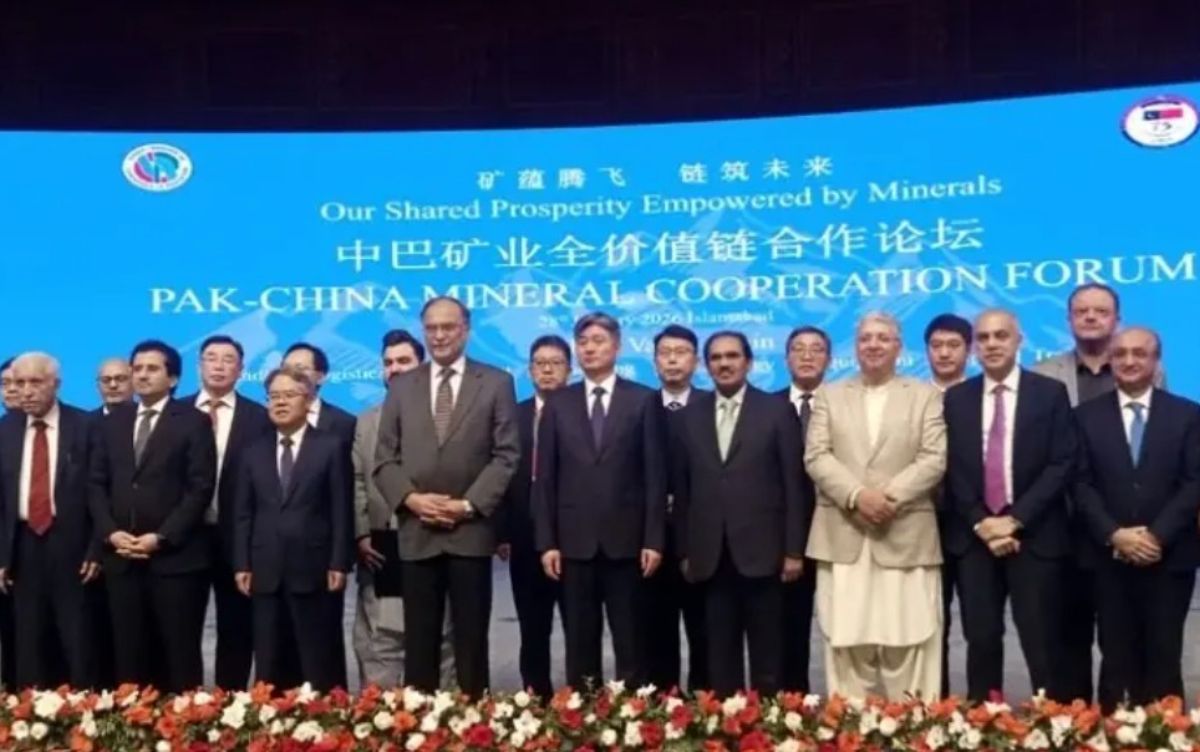 P.c. China Pakistan Economic Corrdior
Despite hosting around 5,000 operational mines producing nearly 68.5 million metric tonnes, Pakistan’s mineral exports remain modest at $2 billion, contributing only 2–3% to GDP. Iqbal highlighted inefficiencies such as outdated blasting techniques and limited geological mapping—only 40% of the land has been surveyed—and called for technology-driven solutions to enhance value.
He projected that exports could rise to $6–8 billion annually within this decade. Moreover, he emphasized that mining initiatives should strengthen national cohesion, delivering jobs, infrastructure, education, and healthcare benefits, particularly to Balochistan and Khyber-Pakhtunkhwa.
The minister reaffirmed the government’s commitment to the safety of Chinese nationals and highlighted the focus on co-creation, innovation, human capital development, and long-term partnerships. Chinese enterprises are invited to lead projects in copper, gold, antimony, tungsten, rare earth elements, and other critical minerals vital for clean energy and advanced manufacturing.
With strengthened Pakistan-China ties under an upgraded CPEC, mining is positioned as a key growth sector, enabling the conversion of mineral wealth into industrial strength, competitive exports, and shared prosperity. Recent milestones include Pakistan’s first shipment of enriched rare earth elements and critical minerals to the U.S., marking the country’s entry into strategic global supply chains.